

The Future of Architecture Is Human + AI
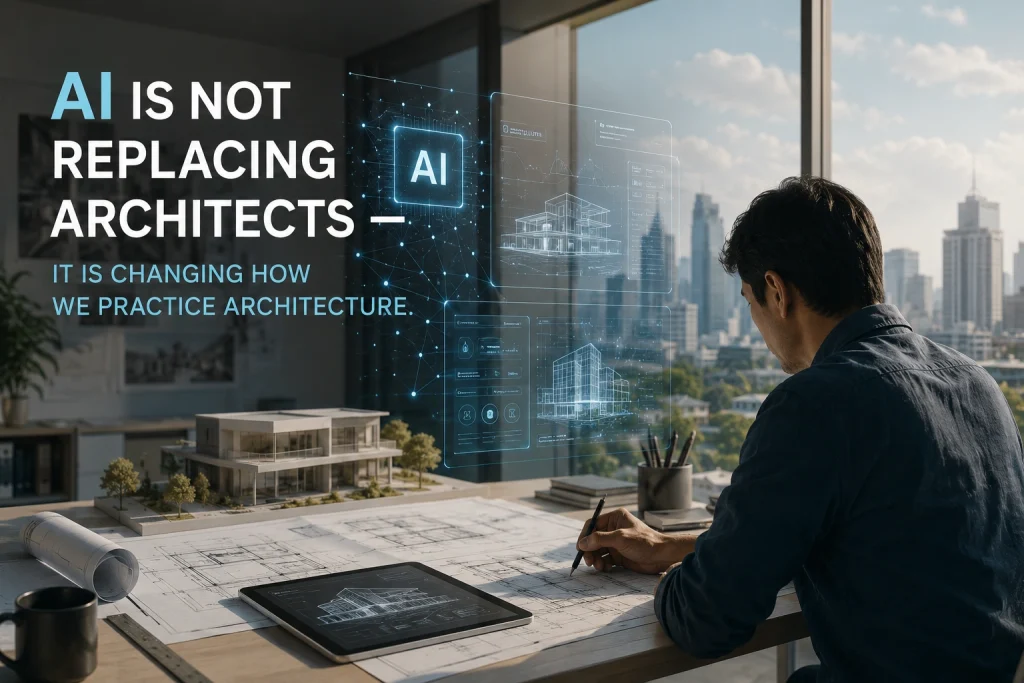
Artificial Intelligence is rapidly changing the way we work.
We can now generate images in seconds, summarize documents, analyze information, automate repetitive tasks, explore design ideas, and perform calculations that once took considerably more time.
Naturally, this has raised a question within the architecture and construction industry:
Will AI eventually replace architects?
Probably not.
But architects who learn how to work effectively with AI may have a significant advantage over those who choose to ignore it.
AI Is a Tool, Not the Architect
Architecture has always evolved alongside technology.
Architects once drafted almost everything by hand. Then came CAD. Later, 3D modeling, BIM, rendering software, drones, laser scanning, cloud collaboration, and increasingly sophisticated construction-management systems became part of professional practice.
None of these eliminated the architect.
They changed how architects work.
Artificial intelligence may represent another major step in that evolution.
AI can help architects generate concepts, organize information, study alternatives, prepare presentations, analyze data, improve workflows, and automate repetitive processes.
But producing information is not the same as practicing architecture.
An architect must understand the client, the site, the budget, the climate, the building regulations, the construction process, and the people who will eventually occupy the building.
AI can assist with these decisions.
It cannot assume the professional responsibility behind them.
Where AI Can Actually Help Architects
There are many parts of architectural practice where AI can already be useful.
1. Faster Concept Exploration
Architects can use AI-assisted visualization to explore materials, colors, landscaping, interior character, façade treatments, and different design directions much faster than before.
Instead of spending hours producing every preliminary visualization, an architect can test several possibilities before deciding which ones deserve further development.
The important distinction is that AI generates possibilities; the architect evaluates them.
A beautiful generated image is not automatically good architecture.
It may contain impossible structures, impractical spaces, incorrect dimensions, poor circulation, inappropriate materials, or details that simply cannot be constructed.
Architectural judgment remains essential.
2. Reducing Repetitive Work
A surprising amount of professional practice involves work that is necessary but repetitive.
Documentation, schedules, reports, specifications, correspondence, checklists, quantity information, meeting summaries and administrative tasks can consume a considerable amount of an architect’s time.
AI and automation can help reduce some of this workload.
That does not necessarily mean doing less work.
It can mean allowing architects to spend more of their working hours on the tasks that actually require architectural judgment.
3. Better Access to Information
Architects constantly deal with large amounts of information: codes, product specifications, project documents, construction methods, costs and technical requirements.
AI can make searching, organizing and interpreting information considerably faster.
But this comes with an important warning:
AI-generated information must still be verified.
AI systems can misunderstand context, provide outdated information or confidently produce incorrect answers.
For professional work, verification remains the responsibility of the professional.
4. Estimating and Pre-Construction
Technology can also improve the connection between design and construction.
Early design decisions have cost consequences.
Floor area, structural systems, finishes, wall quantities, roofing configuration and many other decisions eventually affect the project’s budget.
Digital tools can help architects, engineers and builders evaluate these consequences earlier instead of waiting until the drawings are substantially complete.
These tools can improve efficiency, but the professional still needs to understand the assumptions behind the numbers and determine whether the results make sense for the actual project.
What AI Still Cannot Understand Like an Architect
Architecture is not simply the production of drawings.
A client may say:
“Gusto ko lang ng simple na bahay.”
But what does “simple” actually mean?
Simple to construct?
Simple aesthetically?
Low maintenance?
Affordable?
Minimalist?
Easy to expand later?
An architect discovers these things through conversation, observation and professional judgment.
The architect also considers things that may never appear in an AI prompt:
How does the afternoon sun hit the property?
Where does rainwater naturally flow?
How does the family actually use the kitchen?
Will an elderly parent eventually live here?
Can construction materials easily be sourced in the area?
Will the proposed detail survive Philippine weather?
Can the client realistically afford to maintain what is being designed?
These decisions require context.
And architecture is fundamentally contextual.
A Rendering Is Not Architecture
This distinction is becoming increasingly important as AI-generated architectural images become more realistic.
Anyone can now generate an impressive-looking house.
But an image does not tell us whether the structure works.
It does not guarantee that the stairs comply with requirements, the rooms have adequate dimensions, drainage has been resolved, structural loads have been considered, waterproofing details work, utilities can be installed properly, or the building can actually be constructed within the client’s budget.
AI can produce an image of architecture.
That does not automatically make it architecture.
Between an attractive concept and a functioning building are hundreds — sometimes thousands — of decisions made by architects, engineers, contractors, suppliers, craftsmen and clients.
The Architect’s Role May Actually Become More Important
As generating information becomes easier, determining which information is correct and appropriate becomes increasingly valuable.
Architects may gradually spend less time simply producing drawings and more time evaluating alternatives, coordinating systems, validating information and making decisions.
In other words, the profession may shift from merely producing information toward curating, interpreting and taking responsibility for it.
That requires expertise.
AI can suggest.
The architect must decide.
AI can generate.
The architect must verify.
AI can calculate.
The professional must determine whether the assumptions behind the calculation are correct.
Architects Should Not Be Afraid of AI
There is every reason to be cautious about artificial intelligence.
There are legitimate concerns involving accuracy, copyright, employment, privacy, professional liability and the misuse of generated information.
But refusing to use the technology altogether may not be the answer either.
Architects should learn it.
Experiment with it.
Understand where it performs well.
More importantly, understand where it fails.
The goal should not be to allow AI to practice architecture for us.
The goal should be to use AI so that we can practice architecture better.
The Future Is Architect + Technology
The future of architecture probably will not be a competition between architects and artificial intelligence.
It will be a collaboration between human expertise and increasingly capable digital tools.
The architect still brings something technology cannot simply generate on command:
judgment, accountability, empathy, experience and understanding of place.
AI may help us draw faster.
It may help us calculate faster.
It may help us visualize, research and communicate faster.
But ultimately, someone still has to ask:
Is this appropriate for the client?
Will this work on this particular site?
Can we actually build it?
Is it safe?
Does it make sense?
And perhaps most importantly:
Is this the right decision?
That is where the architect remains essential.
RCA Build Pro Construction OPC embraces technology as a tool for improving architectural design, pre-construction planning and project delivery. We believe the best use of technology is not to remove professionals from the process, but to give them better tools to design, plan and build responsibly.